
A look into Arizona’s Luxury Home Market Q1-2026
Arizona Luxury’s Defining Moment
Why the state’s ultra-high-end housing market is accelerating at a historic pace
There are moments in a market cycle when the numbers become too consistent to dismiss and too meaningful to call temporary. Arizona’s luxury housing market appears to be in one of those moments.
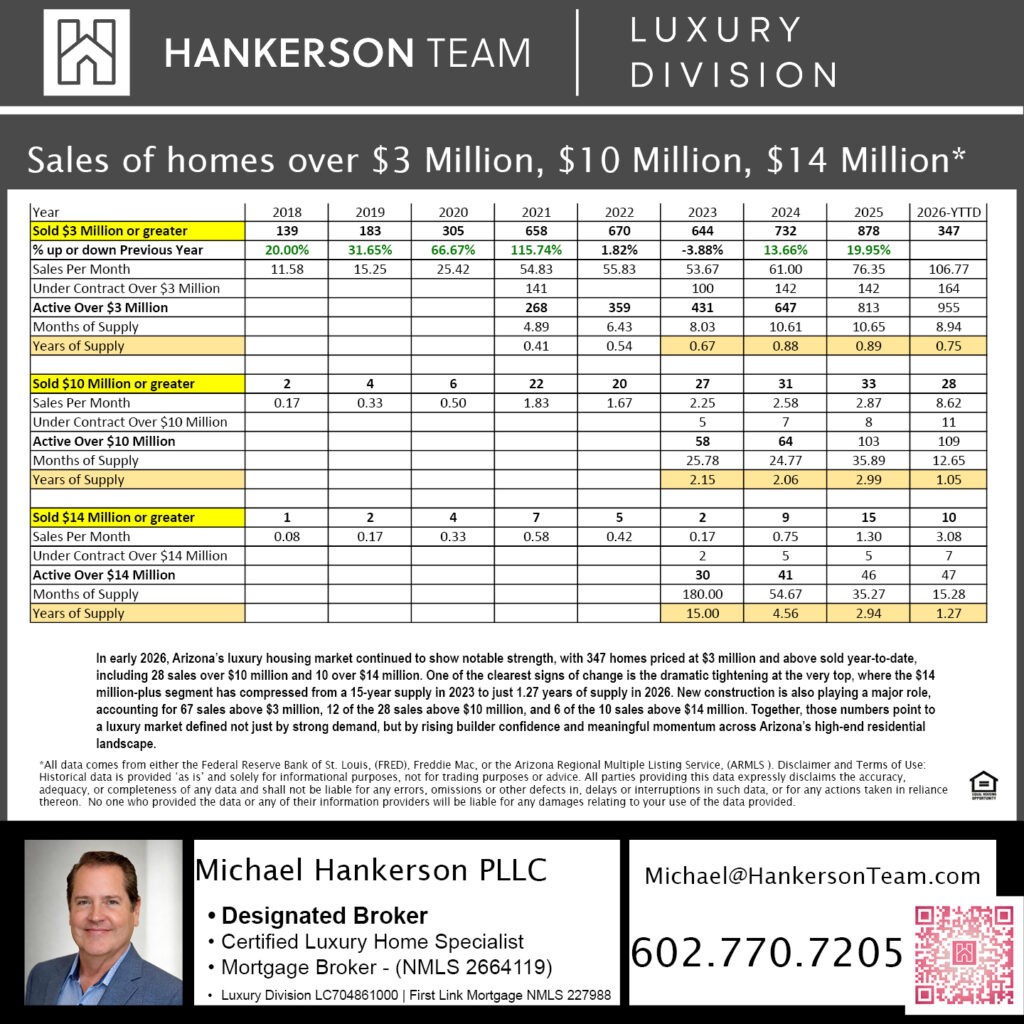
As of April 7, 2026, the state’s upper tier is showing notable strength. In the $14 million-and-above segment, first-quarter sales have already exceeded every prior year except 2025. In the $10 million-and-above category, Q1 sales have already surpassed every prior year except 2024 and 2025. Even more broadly, 347 homes priced at $3 million or more have sold year-to-date, reinforcing that this is not just a story at the extreme top of the market, but across Arizona’s luxury sector more broadly.
What stands out is not simply that the market is active. It is how the activity is being sustained across price points that are, by nature, limited and highly selective. Luxury buyers are typically more deliberate. They do not move in large waves without reason. That is what makes the first-quarter performance so important. It points to real demand, not just isolated headline transactions.
The most striking signal, however, remains inventory compression at the very top.
In 2023, the $14 million-plus segment was carrying roughly a 15-year supply. In 2026, that figure has narrowed to just 1.27 years of supply. That is one of the clearest indicators of transformation in the Arizona luxury market today. A segment once defined by excess time and limited absorption is now operating with far tighter conditions, suggesting a meaningful shift in how quickly elite inventory is being absorbed.
That shift becomes even more compelling when new construction is part of the story.
Of the 347 homes sold for $3 million or more in 2026, 67 were new builds. In the $10 million-plus segment, 12 of the 28 closed sales were new construction. In the $14 million-plus category, 6 of the 10 closed sales were new builds. Those are significant shares, especially at the highest price points, where construction timelines are long, capital exposure is high, and builders must make decisions years before the final buyer appears.
That matters because builder activity is one of the clearest forward-looking indicators in luxury real estate. When builders choose to start homes that may take one to four years to complete, they are not reacting to short-term noise. They are expressing confidence in the depth, durability, and future direction of the buyer pool. In that sense, new-construction sales are doing more than adding volume to the market. They are reinforcing the idea that experienced market participants believe Arizona’s luxury momentum has substance.
The broader over-$3 million market adds useful context. According to the statistical market analysis for 2026, 356 listings in this category have closed, while 927 remain active, 72 are pending, 75 are under contract with backups, 61 have expired, and 172 have been canceled. On average, closed sales in the segment achieved 95% of list price, with 123 average agent days on market and 137 cumulative days on market. In the most recent three-month period shown on page 1, the median comparable sale price was $4.05 million, the median days on market for comparable sales was 82, and the median sale-to-list-price ratio improved to 96.02%.
Those figures suggest a market with real movement, but not irrational exuberance. Homes are selling. Buyers are engaging. Yet properties still need to be priced and positioned correctly, and not everything is being absorbed indiscriminately. That nuance is important. This is a strong luxury market, but it is still one where quality, presentation, timing, and pricing discipline matter.
Across the major luxury categories, sales-per-month metrics are also exceptional. The $14 million-plus segment is running at 3.08 sales per month in 2026, compared with 1.30 in 2025 and 0.17 in 2023. The $10 million-plus market is running at 8.62 sales per month in 2026, compared with 2.87 in 2025. At $3 million and above, the market is running at 106.77 sales per month year-to-date. These are unusually strong absorption figures for markets at this level.
The contrast with the broader Arizona housing market is also worth noting. The overall single-family market is performing adequately, with 5,015 homes sold in April 2026, average sale price holding near $768,364, and a demand-to-supply ratio of 41.37%. That is a functioning market. But the luxury segment is showing a different level of intensity, especially in its absorption patterns, supply compression, and builder participation.
For sellers, this creates an encouraging environment, particularly for properties with genuine distinction. Exceptional design, premier locations, privacy, architecture, views, and finish quality still matter enormously, but in a tighter top-end market, those attributes can command more focused attention.
For buyers, the message is equally important. Arizona still offers many of the characteristics affluent purchasers value most: lifestyle appeal, climate, newer housing stock, and a growing reputation as a destination for luxury living. But the data suggests that the highest tiers are no longer defined by abundant time and unlimited choice, especially when it comes to standout homes and new construction.
For builders and developers, early 2026 may be providing something even more valuable than momentum: validation. When new construction is accounting for such a meaningful share of closed sales above $10 million and $14 million, it suggests Arizona’s luxury market is not simply benefiting from resale scarcity. It is supporting fresh, high-basis product at the very top.
That is why this moment feels important.
Not because the market should be overstated, and not because every metric points to perfection. But because the combination of sales activity, shrinking supply, improving sale-to-list ratios, and visible builder confidence paints a picture of a luxury market with real strength and unusual depth. Arizona’s ultra-high-end sector is not relying on a hopeful narrative. It is producing evidence.
And in luxury real estate, that is what gives a market staying power.
If you have any questions or comments, please feel free to reach out to Michael Hankerson at 602.770.7205