Physician Loan Arizona: Home Financing for Doctors and Medical Professionals
A doctor can have a strong income and still find that a traditional mortgage does not fit the way a medical career begins.
Years of education may have created a substantial student-loan balance. Savings may still be building. A resident, fellow, or newly hired physician may have a signed employment agreement but has not received the first paycheck.
That does not necessarily mean the borrower is unqualified.
It may mean the borrower needs a mortgage program designed to evaluate medical professionals differently.
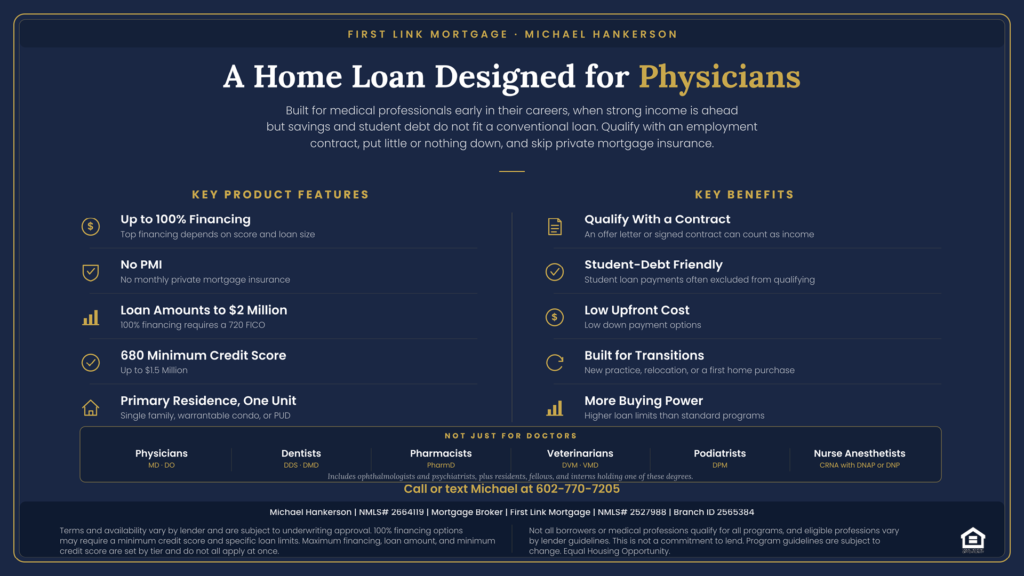
A physician loan in Arizona, sometimes called a doctor loan or physician mortgage, is designed for eligible medical professionals whose employment history, student debt, available savings, or future income may not fit traditional mortgage guidelines.
Depending on the borrower’s qualifications and participating lender guidelines, physician loan options may offer:
- No down payment for qualified borrowers
- No private mortgage insurance with certain programs
- Loan amounts that may reach $2 million
- Qualification using an acceptable employment contract or offer letter
- Flexible treatment of certain student-loan payments
- Fixed-rate and adjustable-rate mortgage options
The important question is not simply whether physician loans exist.
It is whether the program fits your degree, employment start date, student loans, credit profile, target property, available funds, and requested loan amount.
Important program disclosure: Terms and availability vary by participating lender and are subject to underwriting approval. No-down-payment options may require a minimum credit score and are subject to specific loan limits and program requirements. Not all borrowers or medical professionals will qualify.
No down payment does not mean no cash is required. Borrowers may still need funds for closing costs, prepaid property taxes and insurance, inspections, appraisal fees, required reserves, homeowners association charges, and other transaction-related expenses.
What Is a Physician Loan?
A physician loan is a mortgage program developed for doctors and certain other medical professionals.
Traditional mortgage underwriting usually considers the borrower’s current income, employment history, monthly debts, savings, down payment, credit, and property type.
Those requirements can create challenges for someone who has recently completed medical training.
A new doctor may have:
- Strong expected income
- A signed employment contract
- Limited earnings history in the new position
- A significant student-loan balance
- Less money available for a traditional down payment
- An upcoming relocation for residency, fellowship, or employment
A physician mortgage is structured to account for some of these circumstances.
It does not eliminate underwriting. The borrower must still document income, credit, assets, employment, occupancy, and other required information.
The difference is that participating lenders may evaluate an eligible medical professional under guidelines designed for that borrower profile.
Can a Doctor Buy a Home With No Down Payment?
Certain physician loan options may allow a qualified doctor or eligible medical professional to purchase a primary residence with no down payment.
Availability can depend on:
- Credit score
- Requested loan amount
- Medical degree or profession
- Employment status
- Debt-to-income ratio
- Available assets and reserves
- Property type
- Primary-residence occupancy
- Participating lender guidelines
A no-down-payment option may help an eligible medical professional preserve savings rather than using a large portion of available cash for a traditional down payment.
That can be useful for someone who recently completed medical school, is relocating for a new position, or wants to retain funds for moving expenses, furnishing the home, emergencies, or other priorities.
However, no down payment does not mean the borrower can purchase a home without any money available.
A borrower may still need funds for:
- Closing costs
- Prepaid property taxes
- Homeowners or hazard insurance
- Inspections
- Appraisal costs
- Moving expenses
- Required financial reserves
- Homeowners association charges, when applicable
- Other expenses related to the purchase and closing
The exact amount needed depends on the property, loan program, lender requirements, negotiated seller contributions, and the borrower’s circumstances.
The goal is not simply to bring as little money as possible to closing.
The better question is how much cash you want to use for the purchase and how much you want to keep available after closing.
Do Physician Loans Require Private Mortgage Insurance?
Certain physician loan options may not require private mortgage insurance.
Private mortgage insurance, commonly called PMI, is often associated with conventional mortgages when the borrower makes a smaller down payment.
PMI adds another expense to the monthly housing payment.
The ability to obtain a no-down-payment or low-down-payment mortgage without PMI can be an important benefit for eligible doctors who want to purchase a home without using most of their available cash.
No PMI does not automatically make a physician loan the best option for every borrower.
The complete mortgage should be reviewed, including:
- Interest-rate structure
- Closing costs
- Fixed or adjustable rate
- Monthly housing obligation
- Required reserves
- Expected length of ownership
- Future relocation plans
- Available loan alternatives
A mortgage should support what the borrower is trying to accomplish, not simply offer the smallest possible down payment.
Who May Qualify for a Physician Mortgage?
Despite the name, physician loans are not always limited to physicians.
Eligible borrowers frequently include:
- Medical doctors, MD
- Doctors of osteopathic medicine, DO
- Dentists with a DDS or DMD
- Pharmacists with a PharmD
- Veterinarians with a DVM or VMD
- Podiatrists with a DPM
- Certain certified registered nurse anesthetists with a qualifying DNAP or DNP
- Medical residents
- Medical fellows
- Medical interns
Residents, fellows, and interns generally need to hold an eligible degree.
Ophthalmologists and psychiatrists may qualify through their MD or DO designation.
A healthcare-related occupation by itself does not guarantee eligibility. Participating lenders may define eligible professions differently.
Eligible professions vary by participating lender guidelines.
The borrower’s degree, license, employment, training status, and complete financial profile should be reviewed before assuming the program applies.
Can a Doctor Qualify With an Employment Contract?
An eligible borrower may be able to use an acceptable employment contract or offer letter to document future income.
This can help a medical professional who is:
- Completing residency or fellowship
- Relocating for a new medical position
- Joining a hospital or medical group
- Beginning work after completing training
- Purchasing a home before receiving the first paycheck
An employment contract is not automatically accepted simply because it lists a future salary.
Underwriting may review:
- Employment start date
- Salary or guaranteed compensation
- Position and medical specialty
- Employer information
- Contract contingencies
- Length of employment
- Time between closing and the start of employment
- Available financial reserves
Employment start date constraints apply; typically requires commencement within 60-90 days of loan closing depending on lender guidelines.
The exact timing requirement varies by participating lender.
A doctor relocating to Arizona should have the employment contract and expected closing date reviewed before selecting a home. That can help determine whether the planned purchase and employment timelines work together.
How Do Physician Loans Treat Student Debt?
Student debt is one of the main reasons doctors investigate physician mortgage programs.
A physician may have a substantial student-loan balance after completing medical school, residency, or specialty training.
Traditional mortgage guidelines may require a student-loan payment to be included in the borrower’s monthly debt-to-income ratio. The qualifying payment used by the lender may not always match the amount the borrower is currently paying.
Physician loan programs may provide more flexible treatment.
Depending on the student-loan status, documentation, and participating lender guidelines:
- An income-based repayment amount may be used
- A documented required payment may be used
- Certain deferred student-loan payments may be excluded
- Additional documentation may be required
Student loans are not automatically ignored for every physician-loan borrower.
The correct treatment can depend on:
- Type of student loan
- Repayment plan
- Deferment status
- Credit reporting
- Current documentation
- Participating lender requirements
This is one reason an online mortgage calculator may not provide an accurate estimate for a physician.
The calculator may make assumptions that do not match the guidelines available for that borrower’s student loans and professional status.
What Types of Homes May Be Eligible?
Physician loan programs are generally intended for a one-unit primary residence.
Eligible property types may include:
- Single-family homes
- Warrantable condominiums
- Homes located in a planned unit development
The borrower must generally occupy the property as a primary residence.
Physician loan programs are typically not intended for:
- Investment properties
- Short-term rentals
- Vacation homes
- Second homes
- Non-owner-occupied properties
Condominium buyers should pay particular attention to project eligibility.
The borrower may qualify financially while the condominium project does not meet a participating lender’s requirements. Reviewing the condominium project early can help identify potential problems before the borrower is under contract.
Is a Physician Loan Only for First-Time Homebuyers?
No. First-time homebuyer status is generally not required.
A physician loan may be appropriate for:
- A resident purchasing a first home
- A doctor relocating to Arizona
- A fellow moving for a new program
- A physician joining a hospital or medical practice
- An established doctor purchasing a different primary residence
- An eligible medical professional who has owned a home before
The borrower must still meet the applicable occupancy, credit, income, asset, property, and underwriting requirements.
Are Fixed-Rate and Adjustable-Rate Physician Loans Available?
Physician mortgage options may include both fixed-rate and adjustable-rate loans.
With a fixed-rate mortgage, the interest rate remains unchanged during the term of the loan unless the borrower later refinances or modifies the mortgage.
An adjustable-rate mortgage generally begins with an initial fixed period. The rate may adjust after that period according to the terms of the loan.
The more appropriate option depends on the borrower’s plans.
A resident who expects to relocate after completing training may evaluate the choices differently from a physician who expects to remain in the home for many years.
Questions worth considering include:
- How long do you expect to own the home?
- Could your career require another relocation?
- Do you expect a significant change in income?
- How comfortable are you with a payment that could change?
- Would you sell the home or keep it after moving?
- How much cash do you want to preserve after closing?
A lower initial payment is not automatically the better mortgage.
The loan structure should fit the borrower’s expected plans for the home.
Why Work With a Mortgage Broker?
There is not one universal physician mortgage available from every lender.
Guidelines can vary based on:
- Medical profession
- Degree
- Credit score
- Employment start date
- Student-loan status
- Loan amount
- Property type
- Down payment
- Available reserves
- Citizenship or residency status
As a mortgage broker, Michael Hankerson can review the borrower’s circumstances and compare physician loan options available through participating lenders.
Michael is also a licensed Arizona real estate broker.
That dual-license perspective can be useful because the financing, home search, purchase contract, property, and closing schedule are all connected.
Questions that may need to be addressed include:
- Does the approved loan amount match the target home price?
- Will the employment start date affect the closing timeline?
- How much cash may be required for closing costs and reserves?
- Is the condominium project eligible?
- How much money should remain available after the purchase?
- Does the prequalification reflect the correct student-loan treatment?
- Does the target property fit the physician-loan guidelines?
Understanding those issues before making an offer can help reduce complications later in the transaction.
Questions to Review Before Applying
A physician loan conversation should begin with what the borrower is trying to accomplish.
Useful questions include:
- What medical degree or professional designation do you hold?
- Are you currently employed, in residency, in fellowship, or beginning a new position?
- Do you have a signed employment contract or offer letter?
- When is the employment scheduled to begin?
- What payment appears on your student-loan documentation?
- What home price are you considering?
- Would you prefer a no-down-payment option, or would you rather make a down payment?
- How much money would you like to retain after closing?
- Are you considering a single-family home, condominium, or PUD?
- How long do you expect to own the property?
The answers help determine which participating lender guidelines may apply.
Frequently Asked Questions About Arizona Physician Loans
What is a physician loan?
A physician loan is a mortgage designed for eligible doctors and certain medical professionals whose income history, student debt, savings, or employment timeline may not fit traditional underwriting.
Can a doctor buy a home with no down payment?
Certain physician loan options may allow qualified doctors and eligible medical professionals to purchase a primary residence with no down payment. Availability depends on credit, loan amount, profession, assets, property, and participating lender requirements.
Does no down payment mean no cash is required?
No. A borrower may still need money for closing costs, prepaid taxes and insurance, inspections, appraisal fees, required reserves, homeowners association charges, and other expenses. The amount needed varies by transaction and lender requirements.
What credit score is required for a physician loan?
Credit-score requirements vary based on the participating lender, requested loan amount, down-payment option, property, and the borrower’s complete qualifications.
What is the maximum physician loan amount?
Available physician loan options may permit loan amounts up to $2 million. The amount available depends on borrower eligibility, credit, property, income, assets, and participating lender guidelines.
Can residents and fellows qualify?
Medical residents, fellows, and interns with an eligible degree may qualify, depending on the participating lender’s guidelines.
Can future income be used?
An acceptable employment contract or offer letter may be used to document future income. Employment start date constraints apply and typically require employment to begin within a defined period after closing.
Are student-loan payments excluded?
Certain student-loan payments may be excluded in qualifying circumstances. In other cases, an income-based or documented monthly payment may be used. The treatment varies by student-loan status and participating lender.
Is private mortgage insurance required?
Certain physician loan options may not require private mortgage insurance, including some programs offering no-down-payment options.
Can the loan be used for an investment property?
Physician loan programs are generally limited to a one-unit primary residence.
Does the borrower have to be a first-time homebuyer?
No. First-time homebuyer status is generally not required.
Find Out Which Physician Loan Guidelines Apply to You
A physician loan may help an eligible medical professional purchase a home while preserving savings, managing student debt, or preparing to begin a new position.
Potential benefits may include no-down-payment options, no private mortgage insurance with certain programs, future-income qualification, and flexible treatment of certain student loans.
But the details matter.
Your profession, degree, credit profile, requested loan amount, employment start date, student loans, available assets, and target property can all affect eligibility.
No down payment also does not mean no money will be required for the transaction. Closing costs, prepaid expenses, reserves, and other costs may still apply.
The real question is not simply whether you are a doctor.
It is whether the available physician loan options fit your particular situation.
Call or text Michael Hankerson directly at 602-770-7205 to review the physician mortgage options that may be available to you.
Terms and availability vary by participating lender and are subject to underwriting approval. No-down-payment options may require a minimum credit score and are subject to specific loan limits and program requirements. Loan limits, eligible professions, credit requirements, property requirements, employment start-date restrictions, and student-loan treatment vary by participating lender. Not all borrowers or medical professionals will qualify.
Michael Hankerson | NMLS# 2664119
Mortgage Broker | First Link Mortgage | NMLS# 2527988
Branch ID 2565384
Equal Housing Opportunity
This information is provided for educational and marketing purposes and is not a commitment to lend. All loans are subject to borrower eligibility, credit approval, income and asset verification, property approval, participating lender guidelines, and program availability. Terms, conditions, loan limits, and eligibility requirements are subject to change. Not all borrowers will qualify.